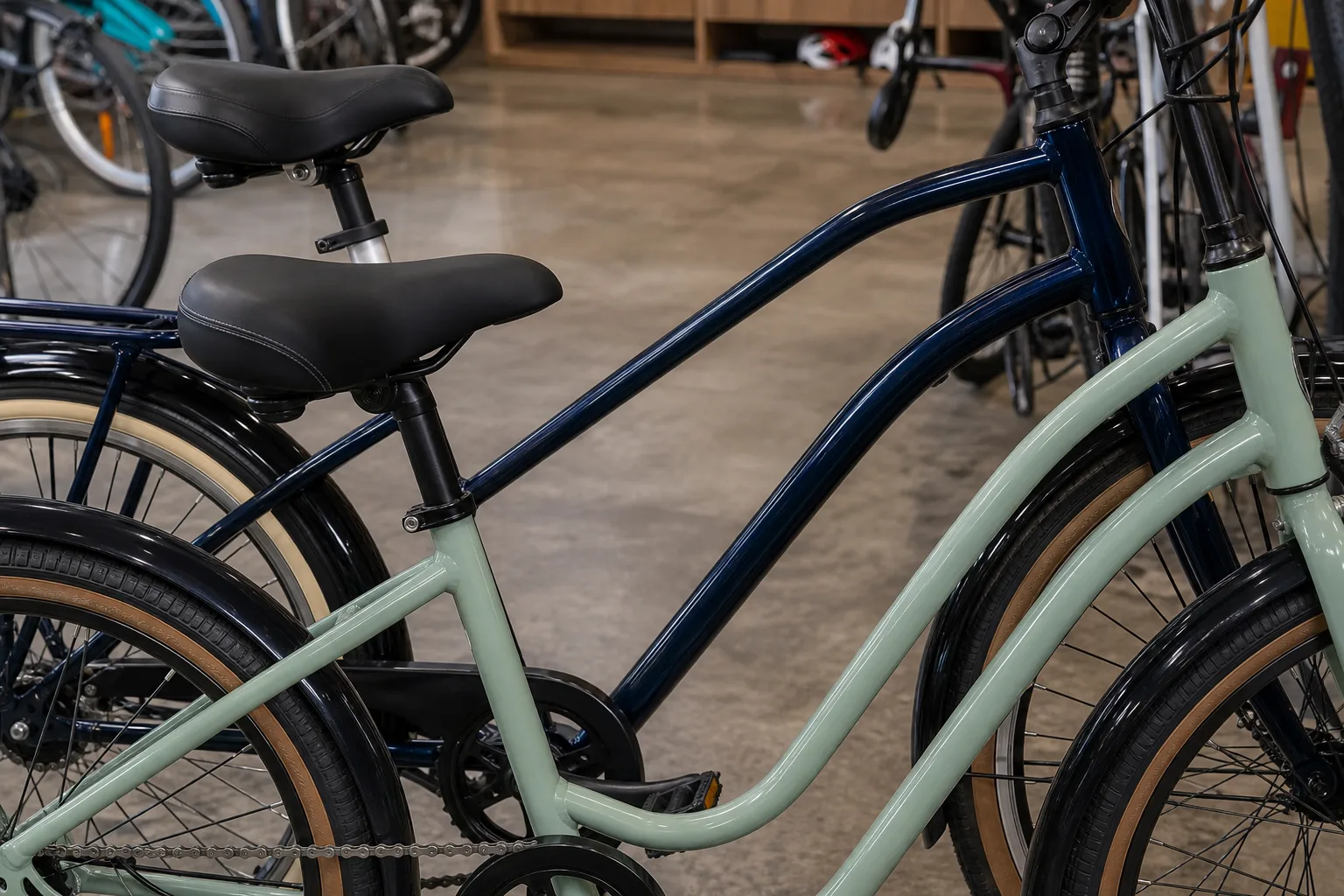
A shop in a coastal town keeps two cruisers on the same rack, one badged as a men's model and one as a women's, both listed as medium, both 26-inch wheels, both with swept-back bars. The tape measure says the standover heights differ by about an inch and a half, the cranks by five millimeters, and the saddles by roughly three centimeters across the sit-bone platform. The frames are otherwise identical castings with different paint. That combination, three real changes and a dozen imagined ones, is the ordinary case, and it is why the label alone will not tell a careful reader what they are buying.
The useful habit is to stop treating the model name as information and start treating the geometry table as the only thing that carries a number.
The six dimensions that actually move
Six measurements account for nearly every genuine difference between a women's-specific bicycle and its counterpart, and each one can be checked in a showroom or a garage. Standover height is the distance from the ground to the top of the top tube at the point where you would straddle it, and step-through frames drop it dramatically rather than by an inch. Effective top tube length, measured horizontally from the head tube to a point above the bottom bracket, sets how far forward you reach. Crank length, stamped on the inside of the crank arm, typically runs 165 to 175 millimeters. Saddle width, brake lever reach, and grip diameter fill out the list.
Three of those six are components, not frame geometry, which matters more than it sounds. A saddle, a lever, and a pair of grips can be swapped in under an hour for well under the cost of a different bike, so a model split built only on those parts is a convenience, not a constraint. The frame numbers, standover and top tube length, are the ones you cannot change after the sale. Read them first, and read the parts list second.
Reading two spec charts side by side
Open both manufacturer geometry tables and compare row by row, size by size, ignoring which page you are on. Look for effective top tube, standover, head tube angle, seat tube angle, wheelbase, and stack. If the men's medium and the women's medium share every one of those figures, you are looking at one frame in two colors, and the choice comes down to saddle, grips, and finish. If the top tube is 15 or 20 millimeters shorter on one, or the standover is 30 millimeters lower, the frames are genuinely different and the fit will feel different in a parking lot test.
Watch for the trap of unequal size ranges. A brand may offer the women's version in small and medium only, while the men's runs small through extra-large, which means a tall rider who wants the lower standover is being pushed toward a frame with a shorter reach than her legs and torso want. In that situation, the honest comparison is between the women's medium and the men's small, not between the two mediums, and the numbers usually make that obvious within a minute.
What to verify with the bike in front of you
Manufacturer charts are measured to a standard the manufacturer chooses, so confirm three things in person. Straddle the bike flat-footed in the shoes you will ride in and look for clearance at the crotch; an inch is comfortable on a cruiser you will stop and start often. Wrap a hand around the grip and see whether your fingertips reach past the first knuckle, since grips run roughly 30 to 33 millimeters in outer diameter and a smaller hand is happier at the low end. Then squeeze the brake lever with the pads of the fingers, not the joints, and check that most levers have a reach adjustment screw that moves them 10 millimeters or so closer to the bar.
Where the safety numbers are settled for you
Some of what you might worry about is already fixed. The Consumer Product Safety Commission is responsible for federal bicycle requirements covering things like brake performance, reflectors, and protrusions, and those apply the same way regardless of what the model is called or who it is marketed to. That frees a shopper to spend attention on fit, which no regulator can standardize because it depends on your legs, your torso, and your hands.
Bring a tape measure and a printout of both tables. Ten minutes of arithmetic in the aisle separates a frame built around a different rider from a frame that was painted for one, and either answer is useful once you have it.